Cataract
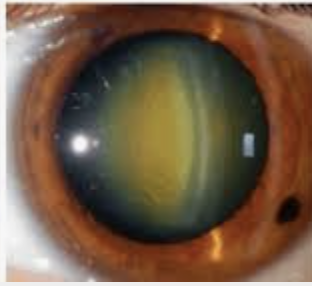
Cataract is a clouding or opacity of the normally
transparent lens inside the eye, thus preventing the light
rays from passing into the eye. It is a part of normal
ageing process, and hence is seen commonly in patients
above 50 years of age. Cataract is managed by surgery
which involves removal of the opaque lens, and
replacing it with an artificial intraocular lens (IOL).
With the advancements in the instrumentation and
techniques, Cataract surgery has become a very reliable,
safe and successful procedure with minimal discomfort
to the patient, and early visual recovery.
What are the symptoms of Cataract?
Cataract usually forms and progresses slowly and
therefore leads to a gradual blurring of vision. It may
also cause other symptoms like frequent change of
glasses, glare, change in colour vision etc.
What is the treatment? Can it be cured by medicines?
There are no medications, eye drops, exercises or
glasses that will cause Cataracts to disappear once they
have formed. Surgery is the only way to remove a
Cataract.
When should one get operated for Cataract?
The timing of Cataract surgery largely depends upon the
needs of the patient. When the vision loss due to
Cataract is significant enough to hamper one's routine
activities, the Cataract may be operated upon. It is not
necessary to wait for Cataract to 'ripen' or 'mature'. In
fact, a more advanced stage of Cataract is sometimes
more difficult to manage by newer techniques like
Phacoemulsification.
Which is the Best Surgical Option?
The best procedure for most patients is stitchless
Phacoemulsification with a foldable Intraocular lens.
However, for some selected patients, an alternative method
may be more suitable.
What is Phacoemulsification?
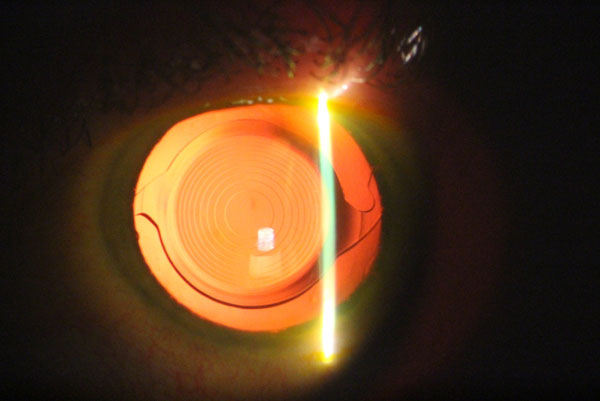
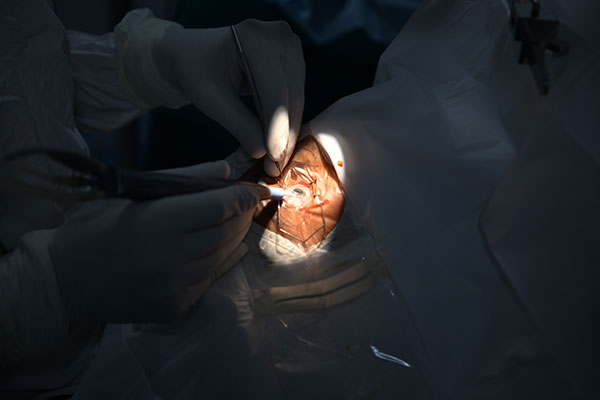
It is a painless procedure using a very small incision.
Through this small incision, the tip of the instrument is
introduced into the eye. This tip uses localized high
frequency waves to break the cataract into very minute
fragments and pieces, which are then sucked out in a
controlled manner through the same tip. A thin 'capsule'
or shell is left behind after cleaning up of the entire
opaque cataract. A foldable intraocular lens is then
inserted through the same small incision and is supported
on this capsule.
What are the advantages of Phacoemulsification over
extracapsular (non-phaco) surgery?
In a non-phaco surgery the incision required is larger
(10-12 mm) and requires stitches for closing. This larger
incision takes 6-8 weeks to heal. Moreover, the stitches
can cause distortion of the normal curvature of the
cornea (the clear part of eye) and thus lead to astigmatism
and blurred vision because of this. In contrast,
Phacoemulsification requires smaller wound of only less
than 2 mm, which does not require stitches, heals
faster with minimum distortion and leads to early visual
recovery and return to work.
What anesthesia is used for the surgery?
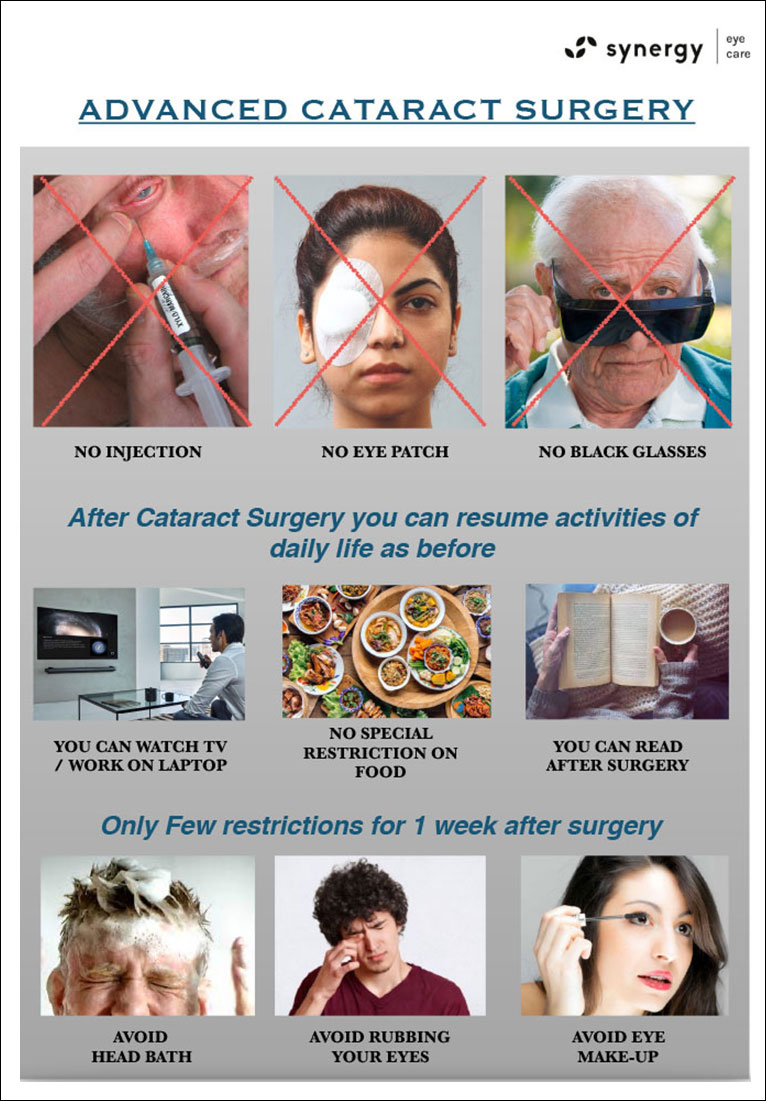
In most of the patients, the surgery is done under local
anesthesia. Most of the times it is performed after putting
only anesthetic drops, and without any injection.
However, in some cases, especially in anxious patients,
local anesthesia in form of injection may be given.
Is admission required for cataract surgery?
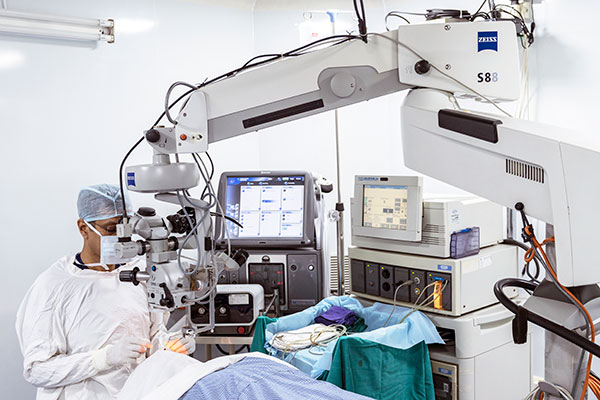
It is a short surgery of about 10 minutes and the
patient can go home after ½-1 hour. So only a short
stay is required.
What are the postoperative precautions?
There is no restriction in reading, watching TV,
walking or eating any type of food. Most of the
patients can resume their office work within a few
days after the surgery. You will have to use eye drops
for about 4 weeks. It is advisable not to splash water on
your open eye or rubbing it for 2 weeks.
Will I need glasses after surgery?
Yes, you may require glasses, which are generally
prescribed 4 weeks after the surgery. The power
required is generally very small and is different for
distance and near vision.
What are the complications of Cataract Surgery?
Cataract surgery is one of the most successful
surgeries. Over 90% of patients operated for cataract
gain a useful vision. But like any other surgery,
problems may develop occasionally in the form of
infection, inflammation of the eye, displacement of
the natural or artificial lens, swelling in the retina
(Cystoid Macular Edema), retinal detachment, etc.
Most of these complications can be managed well if
they are detected early. Hence a good post-operative
follow up must be maintained and in case of any
unusual pain, decreased vision or other symptoms, the
doctor must be consulted immediately.
In some patients, in the months following surgery, the
membrane behind the new lens can get thickened
leading to blurred vision. This is referred to as
capsular opacity or 'aftercataract', and can be
treated easily by laser as an out-patient procedure.
What are the newer developments in Cataract
Surgery?
Micro Incision Cataract Surgery (MICS) can
perform surgery through very small incision, which
heals faster and with minimal distortion.
Zepto Cataract Surgery is the latest technology
using a special disposable Probe to make the critical
step of capsulorhexis very safe, precise and 100%
reproducible and thus decreasing the risks of
complications.
There are many choices of Intra Ocular Lenses (IOLs) like Multifocal IOLs, Extended Vision IOLs, Toric IOLs etc. to give you better quality of vision without glasses. The best suited surgery and IOL option for you shall be decided by the surgeon based on your eye condition and visual needs.
Synergy Eye Care and its Doctors use the latest Surgical Techniques and IOLs to give excellent results in cataract surgeries. The Retina Surgeons of Synergy also successfully handle the complications of Cataract surgeries, referred to them from other ophthalmologists.
Disclaimer: Information published here is for educational purposes only and is not intended to replace medical advice. If you suspect that you have a health problem, please consult your doctor immediately